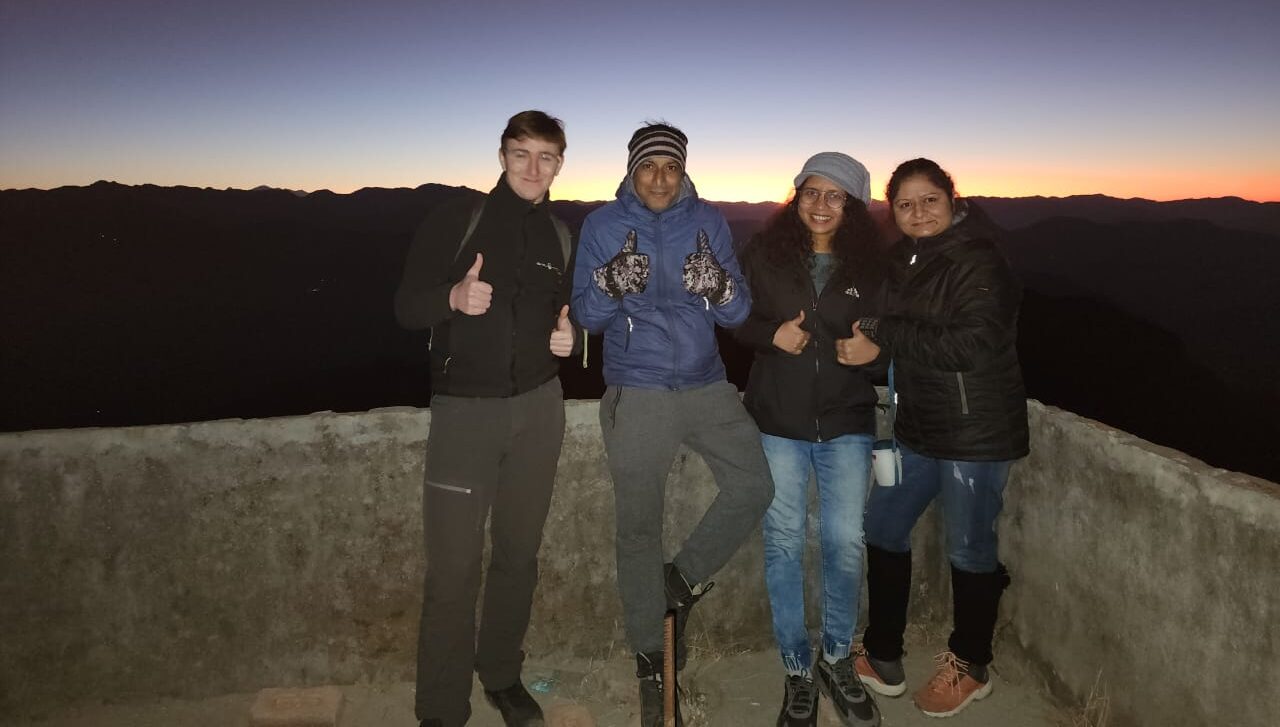
The Kunjapuri sunrise trek Rishikesh is unlike any morning you have ever had. You leave the city in darkness, climb through silent pine forests, and arrive at a Shakti Peeth temple perched 1,676 metres above the Doon Valley — just in time to watch the entire Garhwal Himalayan skyline catch fire. Swargarohini, Bandarpunch, Chaukhamba, Gangotri. One by one the snow peaks glow gold. Below, the Ganga curves silver through Rishikesh and Haridwar as the plains wake up. For those few minutes, nothing else exists.
This guide gives you everything you need to do this trek right — precise sunrise timings for every month, all three route options, what makes Kunjapuri spiritually significant, places you must not miss along the trail, and the expert tips we have gathered from over 22 years of leading this trek from adventure activities in Rishikesh.
Kunjapuri Sunrise Trek — At a Glance
| Location |
Tehri Garhwal, Uttarakhand — 25 km from Rishikesh |
| Altitude |
1,676 m (5,498 ft) |
| Trek Distance |
8 km (downhill) | 12 km (uphill) | 20–21 km (full loop) |
| Duration |
6–7 hours total (drive + temple + trek) |
| Difficulty |
Easy (downhill) | Moderate (uphill) |
| Best Season |
Year-round | Clearest views: October – March |
| Temple Entry Fee |
Free | Open 5:00 AM – 7:00 PM (365 days) |
| Peaks Visible |
Swargarohini, Bandarpunch, Chaukhamba, Gangotri range |
| Spiritual Significance |
One of 51 Shakti Peethas — part of the sacred Tehri Garhwal triangle |
| Best Combo |
Sunrise trek + Ganga river rafting Rishikesh (same day) |
In This Guide
- What Is the Kunjapuri Sunrise Trek?
- Kunjapuri Temple: A Sacred Shakti Peeth
- Kunjapuri Sunrise Timings — Month-by-Month 2026
- The Himalayan Panorama: Peaks You Will See
- Three Trek Route Options
- Trail Highlights: Waterfalls, Villages & Wildlife
- Best Time to Visit by Season
- How to Reach Kunjapuri Temple from Rishikesh
- What to Carry
- Expert Tips from Local Guides
- Frequently Asked Questions
What Is the Kunjapuri Sunrise Trek?
The Kunjapuri sunrise trek is a one-day adventure that begins before dawn in Rishikesh or Tapovan and ends mid-morning after a descent through Himalayan forest and riverside villages. The word Kunjapuri comes from Sanskrit — “Kunja” (bower or hidden grove) and “Puri” (sacred abode). The temple atop the ridge has stood here for centuries as a pilgrimage site, a meditation retreat, and — increasingly — one of the finest sunrise viewpoints in the Garhwal Himalayas.
What separates this from other morning hikes is the combination you get in a single outing: Himalayan panorama, ancient temple, forest trails through oak and rhododendron, traditional villages, and a natural waterfall to cool off at the end. Whether you come for the spirituality, the photography, or simply the feeling of watching the world wake up from above the clouds, Kunjapuri delivers all of it before breakfast.
Kunjapuri Temple: A Sacred Shakti Peeth
Kunjapuri Devi Temple is one of the 51 Shakti Peethas of Hinduism — the sacred sites where parts of Goddess Sati’s body are believed to have fallen after Lord Shiva carried her across the universe in grief. At Kunjapuri, it is said that the chest of Goddess Sati fell here, making the temple one of the most powerful Devi shrines in Uttarakhand.
The temple forms a sacred triangle with two other Shakti Peethas in the Tehri Garhwal district — Chandrabadni Temple and Surkanda Devi Temple. Completing darshan at all three is considered deeply auspicious, particularly during the Navratri festivals in April and October. During Navratri, the temple grounds host a large mela (fair) that draws pilgrims and locals from across the region. The festival of Dussehra is also celebrated with great enthusiasm here.
The temple itself is modest and peaceful — a small sanctum dedicated to Maa Kunjapuri Devi, draped in flowers and incense. The morning aarti at around 6:00 AM coincides perfectly with sunrise, making the experience both visually and spiritually extraordinary. The sound of bells, the smell of jasmine offerings, and the Himalayan backdrop behind the goddess form a memory that simply does not fade.
Spiritual Tip: Remove footwear before entering the temple. Carry a small coconut or flowers for the puja. If your visit falls during Navratri, arrive at least an hour before sunrise — crowds gather early and the atmosphere is electric.
Kunjapuri Sunrise Timings — Month-by-Month 2026
Timing is the single most important variable of this trek. Arrive too late and you miss the golden transition. The table below gives precise sunrise windows for 2026 so you can plan your departure from Rishikesh correctly. The drive from Tapovan to Kunjapuri takes approximately 45–60 minutes — plan to arrive at the temple at least 30 minutes before the sunrise time listed.
| Month |
Sunrise Time |
Leave Rishikesh By |
Visibility |
| January |
7:10 – 7:15 AM |
5:45 AM |
Excellent — clear, crisp |
| February |
6:55 – 7:00 AM |
5:30 AM |
Excellent — peak clarity |
| March |
6:20 – 6:30 AM |
5:00 AM |
Very Good |
| April |
5:55 – 6:10 AM |
4:30 AM |
Very Good — some haze |
| May |
5:30 – 5:40 AM |
4:00 AM |
Good — occasional haze |
| June |
5:25 – 5:35 AM |
4:00 AM |
Good — pre-monsoon haze |
| July – August |
5:45 – 6:00 AM |
4:30 AM |
Variable — clouds likely, misty views dramatic |
| September |
6:00 – 6:15 AM |
4:45 AM |
Good — clearing post-monsoon |
| October |
6:15 – 6:25 AM |
5:00 AM |
Best — crystal clarity |
| November |
6:25 – 6:40 AM |
5:00 AM |
Best — sharpest views |
| December |
7:00 – 7:20 AM |
5:45 AM |
Excellent — possible snow at temple |
Note: Times are approximate and vary with exact date. Always add a 15-minute buffer. During winter, dress warmly — temperatures at the temple can drop to 2–5°C before sunrise. Your guide will confirm the exact departure time based on the day.
The Himalayan Panorama: Peaks You Will See
From the temple courtyard at 1,676 metres, the Garhwal Himalayan range opens up like a theatrical backdrop. This is what makes Kunjapuri different from dozens of other sunrise points — the elevation is high enough to clear the ridge-line, but low enough to keep the peaks at a dramatic angle, filling the entire northern horizon.
| Peak |
Altitude |
Range |
| Swargarohini |
6,252 m |
Bandarpunch Massif |
| Bandarpunch |
6,316 m |
Bandarpunch Massif |
| Chaukhamba I |
7,138 m |
Gangotri Group |
| Gangotri Peak |
6,672 m |
Gangotri Group |
| Kedarnath Peak |
6,940 m |
Kedarnath Group |
Looking south from the temple, the view reverses entirely — Doon Valley, Rishikesh, Haridwar, and the Shivalik foothills stretch toward the horizon. You are standing on the boundary between the plains and the Himalayas, and both worlds lay at your feet.
Three Trek Route Options
One of the smartest things about the Kunjapuri trek is its flexibility. There are three well-established route configurations, each suited to a different fitness level and time availability.
Route 1 — Drive Up, Trek Down (Most Popular)
Route: Rishikesh/Tapovan → Drive to Kunjapuri Temple → Sunrise → Trek downhill: Kunjapuri → Pater Village → Dharkot Village → Neer Garh Waterfall → Tapovan
Distance: 8–10 km (downhill) | Duration: 6–7 hours total | Difficulty: Easy
Best for: Beginners, families, first-timers, photography enthusiasts
This is the route taken by the vast majority of visitors and the one White World Expeditions recommends as the best balance of sunrise experience, physical activity, and safety. You leave Rishikesh or Tapovan at 4:00–4:30 AM depending on the month (see timing table above), reach the temple in a 45-minute drive, climb the 250–300 steps to the temple courtyard, and watch the sunrise unfold over the Garhwal Himalayas.
After the aarti, a light breakfast at a small dhaba near the temple, and exploration of the courtyard, you begin the downhill descent. The trail passes through Pater village and Dharkot village — traditional Pahadi settlements of stone and wood homes built into the hillside — before reaching Neer Garh Waterfall, where most trekkers take a refreshing dip in the natural pool beneath the falls. A 1.5 km road walk or vehicle pickup returns you to Tapovan by mid-morning.
Route 2 — Trek Up, Drive Down (Fitness-Focused)
Route: Tapovan → Secret Waterfall → Badhera Village → Barkot Village → Kunjapuri Temple → Drive back to Rishikesh
Distance: 9–12 km (uphill) | Duration: 4–5 hours trek + drive | Difficulty: Moderate
Best for: Trekkers wanting a physical challenge, those who prefer not to trek downhill on steep terrain
This route begins before dawn from Tapovan — ideally 3:30–4:00 AM to reach the summit in time for sunrise. The trail climbs steadily through thick oak, pine, and rhododendron forests, with the Secret Waterfall appearing about halfway up. This is a cascading stream tucked behind fern-covered rocks — most trail maps don’t mark it, which is how it earned the name. It is a perfect rest point: quiet, cool, and spectacular in monsoon.
The climb through Badhera and Barkot villages gives you the experience of living Himalayan culture — stone walls, terraced fields carved into steep slopes, and children heading to school in the dark while you hike up. Reaching the summit after a four-hour climb and then watching the sun rise makes the effort feel earned in a different way than simply driving up.
Route 3 — Full Loop: Trek Up & Trek Down
Route: Tapovan → Secret Waterfall → Badhera → Barkot → Kunjapuri Temple → Pater → Dharkot → Neer Garh Waterfall → Tapovan
Distance: 20–21 km (complete loop) | Duration: 8–9 hours | Difficulty: Moderate to Challenging
Best for: Serious trekkers, fitness enthusiasts, those wanting a complete wilderness day
The full loop is essentially Rishikesh’s best one-day trek — a complete circuit of the Kunjapuri ridge using different trails for ascent and descent. It demands early starts (3:00–3:30 AM from Tapovan) and solid fitness, but the reward is total immersion in the trail ecosystem. You will pass through four distinct Pahadi villages, two waterfalls, and two completely different forest characters — the dry oak forest on the ascent and the lush rhododendron-rich descent — in a single day.
Trail Highlights: Waterfalls, Villages & Wildlife
Neer Garh Waterfall
Neer Garh is Rishikesh’s largest waterfall — a multi-tiered cascade that drops through a narrow gorge into a natural pool. The water runs year-round from a source near Neer village, though it is most powerful during and just after monsoon. The pool beneath the lower tier is deep enough to swim in and cold enough to immediately clear any tiredness accumulated during the trek. Trekkers doing Route 1 pass directly through Neer Garh as they descend — bring a towel and change of clothes.
Secret Waterfall
Accessible only on the uphill routes (Routes 2 and 3), the Secret Waterfall is a tucked-away cascade roughly 3 km uphill from Tapovan. It is genuinely off the tourist radar — no signboards, no crowds, just the sound of falling water and ferns. The stream that feeds it crosses the trail, and following it upstream reveals the fall itself hidden behind a rock overhang. It is one of those places where you feel like an explorer rather than a tourist.
Himalayan Villages: Barkot, Badhera, Pater, Dharkot
The four villages along the Kunjapuri trail are living museums of Garhwali mountain culture. Stone walls built without mortar. Wooden balconies carved with geometric patterns. Women in traditional pahadi dress carrying loads on their backs using a namlo (head strap). Children playing barefoot in the same lanes their great-grandparents used. Walking through these settlements is a reminder that Himalayan life has a rhythm and resilience completely independent of the city below.
Birdlife
The forest sections of the Kunjapuri trail are excellent for bird watching. Common sightings include the Mountain Bulbul (melodic call that carries across the valley), Purple Sunbird (iridescent plumage visible in the early light), Himalayan Woodpecker, Red-billed Blue Magpie, and the Spotted Owlet if you are out before dawn. Carry binoculars if birds interest you — early morning is peak activity time.
Best Time to Visit — Season by Season
| Season |
Months |
Conditions |
Verdict |
| Autumn |
Oct – Nov |
Crystal clear post-monsoon sky, 15–22°C days, 5–10°C at summit pre-dawn |
Best |
| Winter |
Dec – Feb |
Sharp visibility, occasional snow at temple, 2–8°C pre-dawn — dress warmly |
Excellent |
| Spring |
Mar – Apr |
Rhododendrons blooming, pleasant temperature, good visibility |
Very Good |
| Summer |
May – Jun |
Earliest sunrises (5:30 AM), slightly hazy, lush forests, Char Dham pilgrim rush |
Good |
| Monsoon |
Jul – Sep |
Clouds may obscure sunrise, trails slippery, but misty views are uniquely dramatic — go by vehicle if trekking is not safe |
With Caution |
How to Reach Kunjapuri Temple from Rishikesh
The temple is located in Tehri Garhwal district, approximately 25 km from Rishikesh and 65 km from Dehradun. The approach road is well-paved and accessible all year except during severe monsoon landslides.
| From |
Distance |
Drive Time |
Route |
| Rishikesh / Tapovan |
25 km |
45–60 min |
Via Rishikesh–Tehri highway through Narendra Nagar |
| Dehradun |
65 km |
1.5–2 hours |
Via Gangotri highway and Narendra Nagar |
| Haridwar |
50 km |
1.5 hours |
Via Rishikesh then Tehri highway |
| Jolly Grant Airport |
65 km |
1.5–2 hours |
Via NH58 and Narendra Nagar |
Taxi / Private Vehicle: The most practical option for a sunrise trip. Book the night before — a normal taxi (hatchback or sedan) from Rishikesh to Kunjapuri and back costs approximately ₹1,800–₹3,000. Leave by 4:00–4:30 AM depending on the month.
Shared Jeep: Available from Rishikesh bus stand toward Tehri (alight at Kunjapuri). Around ₹60–₹100 per person, but service starts at 5:30 AM — not ideal for sunrise.
Self-Drive / Motorcycle: Rental motorcycles or scooters (₹400–₹600/day) are popular for those who want full schedule flexibility.
What to Carry
The Kunjapuri trek does not require heavy packing, but a few items make a significant difference in comfort:
| Item |
Why It Matters |
| Trekking shoes with grip |
The descent has rocky and sometimes slippery sections |
| Warm jacket / fleece |
Temperature at the temple pre-sunrise can be 3–8°C even in summer |
| Water bottle (1 litre minimum) |
No reliable water source on the downhill trail until Neer Garh |
| Headlamp or phone torch |
The 250 steps to the temple are unlit in the pre-dawn dark |
| Light snacks |
Small dhabas near the temple, but carry backup energy bars |
| Sunscreen and sunglasses |
UV intensity at altitude is higher than the plains |
| Towel + change of clothes |
For the swim at Neer Garh Waterfall on the descent |
| Camera / phone with full charge |
The golden hour at Kunjapuri is one of Uttarakhand’s most photogenic moments |
| Rain jacket (monsoon only) |
Showers can come quickly during July–September |
| Personal medicines |
No pharmacy on the trail |
Expert Tips from Local Guides
After 22 years of leading the Kunjapuri sunrise trek — in every season, in clear skies and in cloud — here is what we know:
On timing: The 15 minutes before the actual sunrise are often the most spectacular. The sky goes through pink, then deep orange, then gold — and the peaks catch each colour differently. Missing the first light by arriving just as the sun crests the ridge means missing the best of it. Build your departure time around “golden-hour start,” not just sunrise.
On clouds: A cloudy morning is not a wasted morning. Kunjapuri in monsoon or overcast conditions creates a different but equally powerful experience — clouds pour through the valley below the temple like a white river, and you stand above them in clear air. Some of our best photographs from this trek have been taken on “overcast” days.
On the steps: The 250–300 steps to the temple courtyard are steep and unlit before dawn. Take them slowly. There is no competition to be first up the stairs. The sunrise will wait the same amount of time for you whether you sprint or walk.
On photography: Use the railing of the temple courtyard to stabilise your phone or camera in the low pre-dawn light. The best composition is from the northwest corner of the courtyard — it frames Swargarohini and Bandarpunch together. Wait for the exact moment the sun clears the ridge before shooting — the seconds-long transition from shadow to full gold on the peaks is the frame you came for.
On the descent villages: Stop at Barkot. The villagers are used to trekkers and are genuinely welcoming. The chai served in the small wooden tea stall near the upper village is among the best you will have in Uttarakhand — local milk, cardamom, and the unhurried pace of mountain life.
Frequently Asked Questions
What is the best time for Kunjapuri sunrise trek?
October to March offers the clearest sunrise views — dry air, sharp visibility, and snow-capped peaks at full display. April and May are also excellent. Monsoon months (July–August) bring dramatic misty views but cloud cover can obscure the sunrise. Year-round the experience is worthwhile; season shapes the character of it.
What is the Kunjapuri sunrise time today in 2026?
Sunrise at Kunjapuri changes month by month: January–February around 7:00–7:15 AM, March–April around 6:15–6:30 AM, May–June around 5:30–5:45 AM, July–September around 5:45–6:00 AM, October–November around 6:15–6:30 AM, December around 7:00–7:20 AM. See the full timing table above. Arrive 30 minutes before these times.
How long is the Kunjapuri sunrise trek?
The popular drive-up, trek-down route is 8–10 km and takes 3–4 hours of walking. The uphill trek from Tapovan is 9–12 km and takes 4–5 hours. The full loop is 20–21 km over 8–9 hours. Total trip time including driving is 6–7 hours for the standard route.
Is Kunjapuri trek suitable for beginners?
Yes. The most popular version (drive to temple, trek 8 km downhill to Tapovan) is rated easy and suitable for anyone with basic fitness. No trekking experience is required. The uphill option requires moderate fitness and is better for those with some previous hiking experience.
What is the entry fee for Kunjapuri Temple?
Entry is completely free. The temple is open every day of the year from 5:00 AM to 7:00 PM with no charges. Small prasad shops near the entrance sell offerings for the puja.
How far is Kunjapuri Temple from Rishikesh?
Approximately 25 km via the Rishikesh–Tehri highway through Narendra Nagar — a 45–60 minute drive. From Tapovan (White World Expeditions base), it is around 20–22 km.
Which peaks can you see from Kunjapuri Temple?
On clear days you can see Swargarohini (6,252m), Bandarpunch (6,316m), Chaukhamba (7,138m), Gangotri peaks, and Kedarnath peak. Looking south, Rishikesh, Haridwar, and Doon Valley spread below you to the horizon.
What is Kunjapuri’s significance as a Shakti Peeth?
Kunjapuri is one of 51 Shakti Peethas — sacred sites in Hinduism where parts of Goddess Sati’s body fell. The chest of Goddess Sati is believed to have fallen here. The temple forms a spiritual triangle with Chandrabadni and Surkanda Devi in Tehri Garhwal. Navratri (April and October) brings large gatherings and the most spiritually charged atmosphere of the year.
What should I carry for Kunjapuri sunrise trek?
Trekking shoes with grip, warm jacket (the temple is cold pre-dawn), water bottle (1L+), headlamp or phone torch, light snacks, sunscreen, sunglasses, camera with full charge, a towel and change of clothes for Neer Garh Waterfall, and a rain jacket if visiting July–September.
Can I combine the Kunjapuri sunrise trek with river rafting?
Yes — this is one of Rishikesh’s most popular adventure day combinations. Complete the sunrise trek and downhill descent by 10–11 AM, then join an afternoon rafting session on the Ganga. Both fit comfortably in a single day and are available as a Kunjapuri Sunrise Trip package from White World Expeditions.
Plan Your Kunjapuri Sunrise Trek
The Kunjapuri sunrise trek is one of those experiences that does not require weeks of planning or heavy gear. It requires a willingness to set an early alarm and the right people beside you on the trail. At White World Expeditions, our guides have walked this route hundreds of times — in winter frost, in monsoon rain, in the golden clarity of October. We know where to pause for the first light, which village chai is worth the detour, and how to time every detail so you do not miss the moment you came for.
If you are looking for best treks in Uttarakhand beyond Kunjapuri — from weekend snow treks to week-long Himalayan expeditions — explore our full trekking collection.
🌄 Book Kunjapuri Sunrise Trip
📱 WhatsApp: +91-9411527295
22+ Years Experience | Government Registered | 4.9★ (919+ Reviews) | Local Garhwali Guides
About the Author
Bheem Singh Chauhan — Founder & Lead Trek Guide, White World Expeditions
A native of Garhwal with over 22 years of experience guiding treks across Uttarakhand, Bheem Singh Chauhan has led the Kunjapuri sunrise trek in every season. He holds IRF certification, Rescue 3 International credentials, and Wilderness First Responder training (USA). His guides at White World Expeditions are locals who have grown up in the shadow of these mountains. Contact: +91-9411527295